Precision for Complex Composite Components: SL Laser Supports Fiber Placement at Jules Dock Development
Jules Dock Development, based in the Netherlands, specializes in the development and manufacturing of high-quality composite components and prototypes for demanding applications. The company relies on advanced manufacturing technologies and digital processes to produce complex carbon fiber components with exceptional precision.
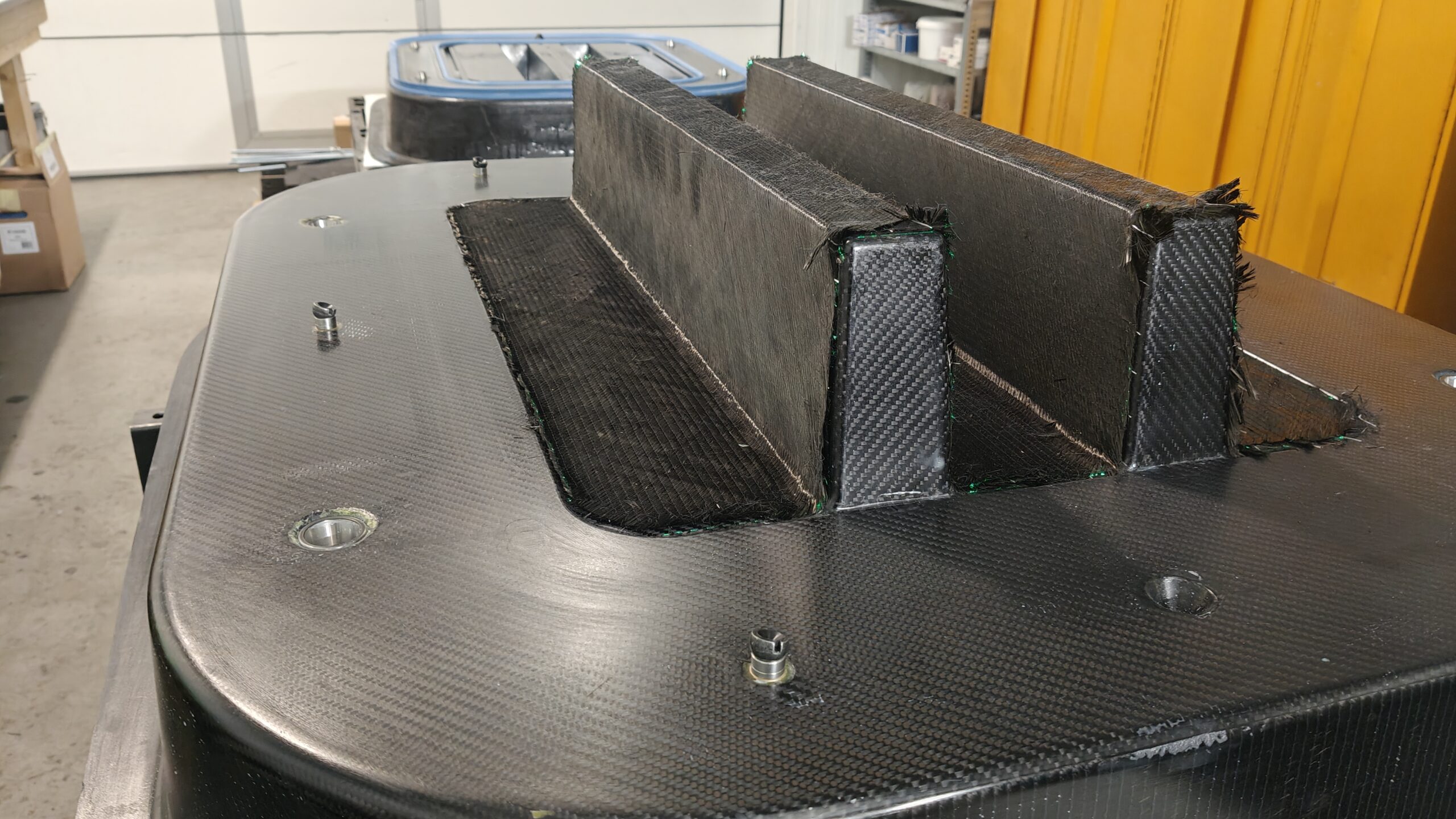
Precision begins long before the actual manufacturing process starts. A recent project with our customer Jules Dock Development demonstrates how a SL Laser projection system is used to support the production of sophisticated carbon fiber components. The goal is to position dry carbon fiber layers precisely on complex mold surfaces before they are infused with epoxy resin.
Laser projection enables precise carbon layup
Dry carbon fibers are extremely flexible and can easily shift or distort during handling. By using laser projection, individual fiber layers can be positioned with an accuracy of approximately one millimeter. The images from the project clearly demonstrate how the projected contours provide precise guidance, even on complex three-dimensional mold surfaces.
Another key advantage is the digital workflow. During mold production, reference targets are integrated to enable precise system calibration. Once calibrated, the SL3D software projects the contours of each individual fiber layer directly onto the mold surface. Additional information, such as ply sequence and fiber orientation, is displayed as well, providing operators with clear guidance throughout every stage of the lay-up process.
Digital Quality Assurance for Reproducible Composite Processes
Quality assurance also benefits significantly from this digital approach. During production, the integrated camera function automatically captures images of each completed layer, creating a complete digital record of the lay-up process. This documentation supports quality control and makes it easier to analyze prototypes and initial production runs. Jules Dock Development also plans to expand its use of the camera system in the future by implementing object recognition and additional automated inspection functions.
This project demonstrates how modern laser projection technology helps to make complex composite manufacturing processes more accurate, repeatable, and efficient. Especially for demanding freeform geometries and applications with stringent quality requirements, the combination of precise laser projection, intelligent software, and digital documentation provides significant added value throughout the production process.